

Understanding the eCTD (electronic Common Technical Document) submission format is fundamental in Regulatory Affairs. This visual summarizes the standardized eCTD structure (Modules 1–5) and highlights how regulatory dossiers are electronically organized, submitted, and lifecycle-managed for health authorities such as the EMA.
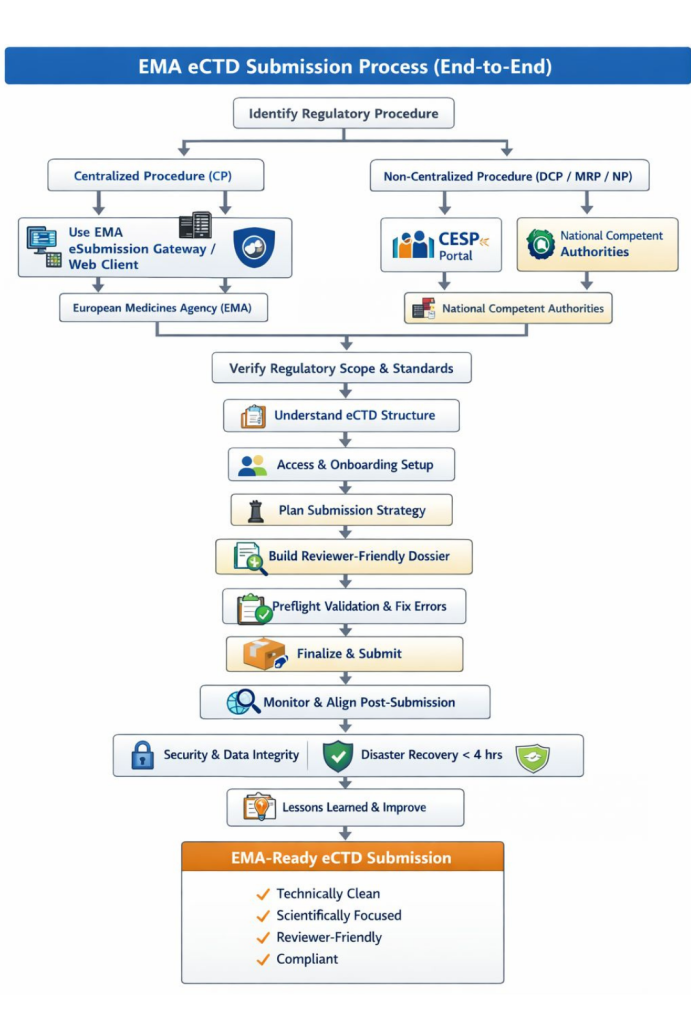
A strong foundation in eCTD formatting ensures regulatory compliance , efficient scientific review , and successful marketing authorization.
My Key Takeaways:
- Centralized Procedure (CP)
- For products assessed at the EU level:
- Submission format: eCTD
- Submission portals:
- EMA eSubmission Gateway (AS2, machine-to-machine)
- EMA Web Client (browser-based)
The Gateway is typically used by high-volume filers, while the Web Client is suitable for most sponsors and CROs. All CP submissions go directly to EMA.
Non-Centralized Procedures (DCP / MRP / NP)
- For submissions assessed by Member States:
- Submission format: eCTD (preferred)
- Submission portal: CESP (Common European Submission Portal)
CESP allows the same dossier to be submitted to multiple national authorities. Always check country-specific file size limits and preferences before submission.
Submission Format-eCTD
- Module 1-Administrative & Product Information
- Module 2-CTD Summaries
- Module 3-Quality (CMC)
- Module 4-Non-Clinical Study Reports
- Module 5-Clinical Study Reports
Module 1 is region-specific (EU, US, Japan differ). Modules 2–5 are harmonized under ICH guidelines.
Final Thought: A successful EMA eCTD submission is the result of early planning, technical precision, and regulatory alignment.
When your dossier speaks the same language as the Agency, reviewers can focus on science—not formatting.
Related Course: Basics of eCTD Submission